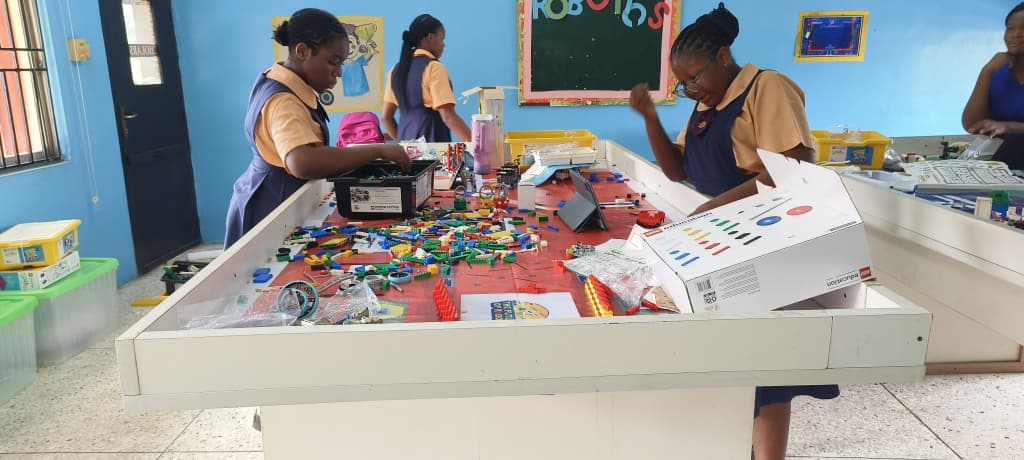
Walk into any of our Lagos robotics labs on a Saturday morning and you'll see it immediately: a child who was quiet twenty minutes ago is now arguing — cheerfully — with a teammate about whether the gear ratio needs adjusting. That argument is the point.
Robotics is one of the few subjects where a child can be wrong, watch the robot fail to do what they expected, and immediately understand why — no waiting for a test to come back, no abstract feedback. The robot either turns the corner or it doesn't. That instant, physical feedback loop is what turns "I don't understand this" into "let me try it differently," and it's a habit of mind that transfers directly into how a child approaches every other hard problem, in school and out of it.
Why the age matters
Under 13, most children haven't yet decided whether they're "a maths person" or "not a maths person." That belief, once it sets in, is remarkably sticky — and it usually forms from a string of abstract failures: a red mark on a test, a formula that didn't make sense. Robotics sidesteps that entirely. A ten-year-old debugging why their robot keeps driving in circles isn't thinking about whether they're good at engineering. They're just trying to fix the circle.
By the time our students reach their teens, many of them have already built, broken, and rebuilt a dozen small machines. That's not a resume line — it's a different relationship with failure than most adults ever get to develop.
What we actually see change
Parents tell us the same thing in different words, week after week: their child asks to log on early, brings up the robot unprompted at dinner, wants to show a grandparent the thing they built. That's not something we can manufacture with a worksheet. It comes from ownership — the robot is theirs, the bug is theirs to solve, the win is theirs to keep.
If you're weighing when to start, our honest answer is: earlier than you'd think, and with less pressure than you'd expect. The goal at 7 isn't mastery — it's curiosity that survives contact with a hard problem. Everything else follows from that.